

Advancing Computational Research • Training Global Scientists • Driving Scientific Innovation
|Registered under the Ministry of SME, Government of India| | ISO 9001: 2015 Certification: Accredited by UASL, United Kingdom |
7-Days Online Hands-on Training
|Online Live Sessions (1 hour Daily)|
Date: 6 October 2026 - 12 October 2026
Timing: Morning Batch: 9:00 AM - 10:00 AM IST (India) or Evening Batch: 9:00 PM - 10:00 PM IST (India)
|Can't attend live? No worries! Participants will receive access to the complete lecture recordings via our web-portal|
|Programming and Coding Knowledge is Not Required|

APPLIED DFT COMPUTATIONS FOR MATERIALS PROPERTIES (DFT-A)
Extension of the DFT-M Training Program
(Electronic | Mechanical | Thermal | Thermoelectric | Optical | Magnetic | Surface & Adsorption)
ENERGY-EFFICIENT MATERIALS, SOLAR & PHOTOVOLTAIC MATERIALS, OLED & OPTOELECTRONICS, BATTERY & ENERGY STORAGE, CATALYSIS & HYDROGEN ENERGY, 2D & NANOMATERIALS, MAGNETIC & SPINTRONIC MATERIALS
Software Packages: Quantum Espresso and Thermo_pw
Speaker: Dr. Nikhil Aggarwal [Acad. Head (CACR); Ph.D. Chemical Science, IIT Madras; M.Sc. (University of Delhi)]
Enrolled participants will also receive access to course recordings and the required software to facilitate effective preparation for the DFT-Basic course.


Introduction
We are glad to announce a 7-Hours Online Hands-on Training program on APPLIED DFT COMPUTATIONS FOR MATERIALS PROPERTIES: Electronic, Optical, Mechanical, Elastic, Thermal & Thermodynamic Properties (using Free Software Tools: Quantum Espresso and Thermo_PW).
-
In recent years, major scientific and industrial interest has been attracted to the multiscale structures involving nanoparticles, thin films, monolayers, etc, and their structure-property relationships. The need for such novel materials demands understanding the changes in structural and dynamical properties caused at the microscopic level.
-
Computational materials science has become an indispensable tool for accelerating the discovery, design, and optimization of advanced materials. While most researchers are familiar with basic Density Functional Theory (DFT) calculations, extracting meaningful structural, mechanical, thermodynamic, thermal, optical, and electronic properties requires advanced computational workflows and a deeper understanding of first-principles methodologies. This intensive hands-on training program is designed to bridge that gap by providing participants with practical experience in computing publication-quality material properties using Quantum ESPRESSO. Through step-by-step demonstrations and guided exercises, participants will gain the skills needed to perform reliable, reproducible, and research-oriented calculations applicable to semiconductors, energy materials, nanomaterials, functional oxides, and other advanced material system.
Deadline- Date : 5th October 2026, 9:00 PM IST (India)
Detailed Daywise Schedule
Day 1: Software Installation, Configuration and Computational Environment Setup
Learning Objectives
-
Install and configure all required software packages. Verify software integration through test calculations.
-
Understand the complete computational workflow used throughout the training.
Hands-on Exercise - Participants will:
-
Install Quantum ESPRESSO, Configure pseudopotential libraries. Execute sample SCF calculation
-
Troubleshoot common installation and configuration issues
Expected Learning Outcome
-
Participants will establish a fully configured and validated computational environment that is ready for all advanced material property calculations covered in the training.
Day 2: Equation of State (EOS) and Structural Characterization
Learning Objectives
-
Understand the relationship between crystal structure and total energy. Determine equilibrium structural parameters. Calculate bulk modulus using first-principles calculations.
Theory
-
Fundamentals of Equation of State, Energy–Volume relationship, Birch-Murnaghan Equation of State, Structural stability
Hands-on Exercise - Participants will:
-
Generate multiple lattice parameters. Perform automated Energy–Volume calculations. Construct EOS curve. Fit Birch-Murnaghan equation
-
Determine: Equilibrium lattice parameter, Equilibrium volume, Bulk modulus, Pressure derivative of bulk modulus
Expected Learning Outcome
-
Participants will accurately determine structural properties and evaluate the compressibility of crystalline materials.
Day 3: Elastic Constants and Mechanical Properties/Characterization
Learning Objectives
-
Evaluate the mechanical stability of crystalline materials, Understand stress-strain relationships, Compute engineering mechanical properties.
Theory
-
Elastic tensor, Stress–strain relationship, Mechanical stability criteria, Voigt approximation, Reuss approximation, Hill approximation, Elastic anisotropy
Hands-on Exercise - Participants will calculate:
-
Elastic constants (Cij), Bulk modulus, Shear modulus, Young's modulus, Poisson's ratio, Elastic anisotropy index, Mechanical stability
Expected Learning Outcome
Participants will compute complete mechanical properties and determine the structural stability of crystalline materials.
Day 4: Thermodynamic Properties/Characterization (Phonon Computations)
Learning Objectives
-
Understand temperature-dependent thermodynamic behavior, Evaluate vibrational contributions to material stability, Compute important thermodynamic functions.
Theory
-
Harmonic approximation, Vibrational thermodynamics, Temperature-dependent properties, Thermodynamic stability, Importance of free energy calculations
Hands-on Exercise - Participants will calculate:
-
Helmholtz free energy, Internal energy, Entropy, Heat capacity (Cv), Temperature-dependent thermodynamic functions
Expected Learning Outcome
-
Participants will evaluate thermodynamic stability and understand temperature-dependent material behavior.
Day 5: Thermal Expansion and Debye Temperature
Learning Objectives
-
Investigate thermal behavior of crystalline materials, Determine thermal expansion characteristics, Estimate Debye temperature from first-principles calculations.
Theory
-
Thermal expansion mechanism, Debye theory, Quasi-harmonic approximation, Temperature-dependent lattice parameters, Volume expansion
Hands-on Exercise - Participants will calculate:
-
Thermal expansion coefficient, Debye temperature, Temperature-dependent lattice parameters, Unit-cell volume expansion
Expected Learning Outcome
-
Participants will evaluate thermal response and thermal stability of crystalline materials over a wide temperature range.
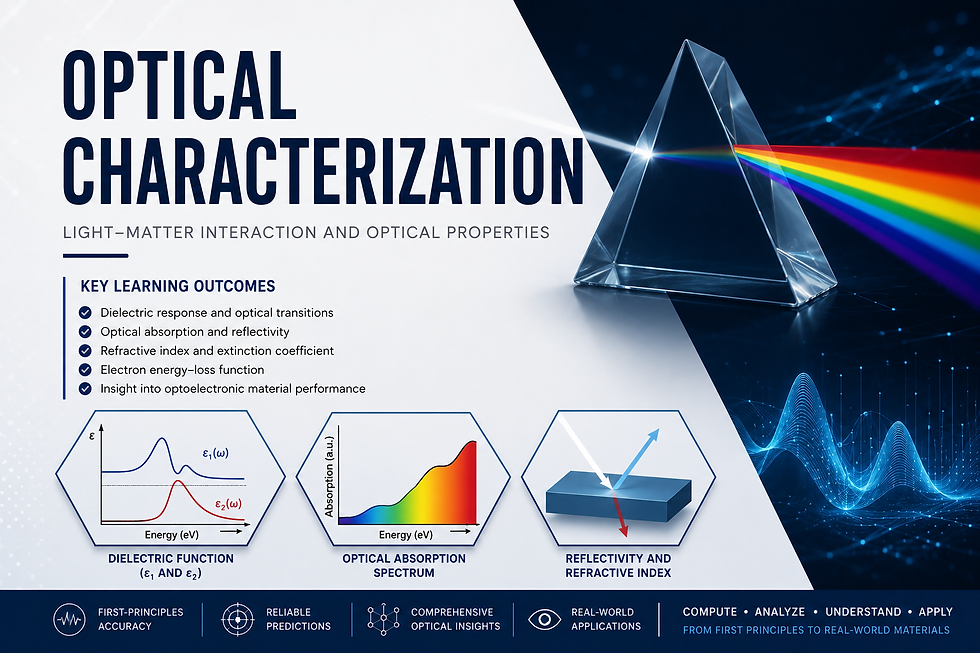
Day 6: Optical Properties of Materials (TD-DFT Computations)
Learning Objectives
-
Understand optical response of crystalline materials, Calculate important optical constants, Interpret optical spectra for advanced materials.
Theory
-
Optical transitions, Complex dielectric function, Optical response of semiconductors, Optical constants, Applications in optoelectronic materials
Hands-on Exercise - Participants will calculate:
-
Real dielectric function (ε₁), Imaginary dielectric function (ε₂), Optical absorption spectrum, Reflectivity, Refractive index, Extinction coefficient, Electron energy-loss function (ELF)
Expected Learning Outcome
-
Participants will generate publication-quality optical spectra and interpret optical behavior using first-principles calculations.
Day 7: Electronic Properties: Partial Density of States (PDOS) and Carrier Effective Mass
Learning Objectives
-
Investigate the electronic structure of crystalline materials, Identify orbital contributions responsible for electronic behavior, Calculate carrier effective masses for semiconductor applications.
Theory
-
Density of States (DOS), Partial Density of States (PDOS), Orbital-resolved electronic structure, Valence Band Maximum (VBM), Conduction Band Minimum (CBM), Effective mass theory, Electron and hole mobility (Quantitative)
Hands-on Exercise - Participants will perform:
-
Partial Density of States (PDOS) and Carrier Effective Mass
-
Atomic projected DOS calculations, Orbital projected DOS calculations (s, p and d orbitals), Orbital contribution analysis near the Fermi level, Identification of VBM and CBM orbital characteristics
-
Electron effective mass, Hole effective mass, High-symmetry k-path generation, Comparison with reported literature values
Expected Learning Outcome
Participants will analyze orbital-resolved electronic structures, determine charge carrier effective masses, and correlate electronic properties with semiconductor, photovoltaic, photocatalytic, thermoelectric, and electronic material performance.
Distinguished International Advisory Board
Featuring Faculty from IITs, NITs and Leading Academic Institutions
%20Satyajit%20Banerjee.jpg)
Prof. (Dr.) Satyajit Banerjee

Professor
Indian Institute of Technology (IIT) Kanpur
Feinberg Postdoctoral Fellowship Awards, Weizmann Institute of Science, Israel
Prof. (Dr.) Sumit Basu

Professor
Indian Institute of Technology (IIT) Kanpur
Postdoctorate: Netherlands at Delft University of Technology & University of Groningen
%20Subrato%20Bhattacharya.jpeg)
Prof. (Dr.) Subrato Bhattacharya

Professor
Banaras Hindu University

Dr. Dinesh Jagadeesan

Associate Professor
Indian Institute of Technology (IIT) Palakkad
Ontario Postdoctoral Fellowship from the Government of Ontario, Canada

Dr. Raghavendra S C

Associate Professor
Higher Colleges of Technology
United Arab Emirates (UAE)

Dr. Satyadeep Waiba
Assistant Professor
Indian Institute of Technology (IIT) Bombay
Postdoctoral Fellowship: University of Bayreuth, Germany

Dr. Suverna Trivedi
Assistant Professor
Indian Institute of Technology (IIT) Kharagpur
Fulbright Postdoctoral Fellow at the University of California, Berkeley

Dr. Sonal Shrivastava
Assistant Professor
Indian Institute of Technology (IIT) Patna
Visiting Researcher at Washington University St. Louis, USA

Dr. Ambuj Kumar Gautam
Assistant Professor
Indian Institute of Technology (IIT) Jodhpur

Dr. Madhusmita Mallick
Assistant Professor
Indian Institute of Technology (IIT) Bhubaneswar

Dr. Santanu Mandal
Assistant Professor
Indian Institute of Technology (IIT) Bhubaneswar

Dr. D N V V Konda Lutukurthi
Assistant Professor
Indian Institute of Technology (IIT) - ISM Dhanbad
Dr. Manwendra Kumar Tripathi
Associate Professor
National Institute of Technology (NIT) Raipur

Dr. Sadhika Khullar
Associate Professor
Dr. B R Ambedkar National Institute of Technology (NIT) Jalandhar
Dr. Kumud Kant Mehta
Associate Professor
National Institute of Technology (NIT) Rourkela

Dr. Nabendu Paul
Assistant Professor
Maulana Azad National Institute of Technology (NIT) Bhopal
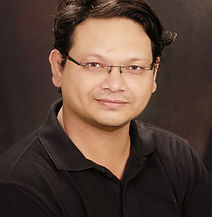
Dr. Paresh Salame
Assistant Professor
Institute of Chemical Technology (ICT) Mumbai
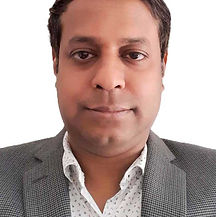
Dr. Anirban Dutta
Assistant Professor
Malaviya National Institute of Technology (NIT) Jaipur

Dr. Himanshu Pandey
Assistant Professor
Sardar Vallabhbhai National Institute of Technology (NIT) Surat
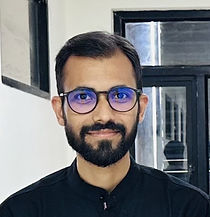
Dr. Kaushik Talukdar
Assistant Professor
National Institute of Technology (NIT) Meghalaya
Participants List: Updated at 7 pm IST, 28 September 2026
No | Order number | First Name | Last Name | Academic Aff. | Institution | State, Country |
|---|---|---|---|---|---|---|
1 | 30ZM-7JWH-6LK | Bramhaiah | Kommula | Assistant Professor | St. Joseph's University, Bengaluru | India |
2 | 30ZM-899F-T4L | Santosh | Tiwari | Assistant Professor | SIES College of Arts, Science and Commerce (Empowered Autonomou) | Maharashtra, India |
3 | 30ZN-ZHM9-ZJ8 | ROHIT | VERMA | Assistant Professor | V.S.K.C. Govt. P.G. College, Dakpathar, Dehradun | Uttarakhand |
4 | 30ZM-HJJ4-XFK | Pradeep | Verma | Research Scholar | BITS PILANI, Pilani Campus | Rajasthan, India |
5 | 30ZT-5VL9-MWJ | Rajnish | Kumar | Research Scholar | Central University of South Bihar | Bihar, India |
6 | 30ZM-7WX3-QV3 | Anjali | Verma | Research Scholar | Homi Bhabha National Institute | Maharashtra, India |
7 | 30ZN-X20S-DKR | SHWETA | SHARMA | Research Scholar | IISER Berhampur | Odisha |
8 | 30ZW-FD75-XDF | SHIVANSHU | MISHRA | Research Scholar | Indian Institute of Technology (IIT) Bhilai | Chhattisgarh, India |
9 | 30ZN-31V2-01N | Shama | Parwin | Research Scholar | Indian Institute of Technology (IIT) Madras | India |
10 | 30ZS-9XM8-LVP | Muskan | Aggarwal | Research Scholar | Manav Rachna University | Faridabad, India |
11 | 30ZM-72NP-FTC | LAVANEETHAN | T | Research Scholar | National Institute of Technology, Trichy | Tamil Nadu, India |
12 | 30ZX-7SPB-XLL | Jitendra | Kumar | Research Scholar | NIT Patna | Bihar, India |
13 | 30ZM-73S8-DQ9 | Vijaykumar | Suryawanshi | Postdoctorate | Somaiya Vidhyvihar University | India |
14 | 30ZM-9JRV-3KV | Palak | Sharma | Research Scholar | Thapar Institute of Engineering and Technology | Patiala |
15 | 30ZM-9WT5-KMF | Manish | KD | Graduate Student | Tripura University | India |
16 | 30ZW-H1WQ-ZPX | Hetasvi | Prajapati | Graduate Student | Vanita Vishram Women's University | India |
Speaker: Dr. Nikhil Aggarwal
Currently, our organisation is under the leadership of Dr. Nikhil Aggarwal, who brings a wealth of knowledge and experience in the computational investigation of molecules, utilising various Density Functional Theory (DFT) approaches. Dr. Aggarwal earned his Ph.D. in Physical Chemistry from the prestigious Department of Chemistry at the Indian Institute of Technology (IIT) Madras in 2017, and he also holds both an M.Sc. and B.Sc. from the University of Delhi. With an impressive portfolio that includes five publications in highly respected international journals, such as those published by the American Chemical Society and Wiley, as well as a book published by Lambert Publishing House in Germany, Dr. Aggarwal has made significant contributions to the field. Furthermore, he was an active participant in the International Conference on Modern Computational Methodologies and Challenges held at the University of Washington, USA, in 2016.
He is actively committed to promoting computational science through online workshops and hands-on training in academic institutions and research industries. We take pride in being the first to offer hands-on training, both online and onsite, in quantum chemical calculations using Density Functional Theory (DFT) approaches. We are proud to announce that in just 5 years, he has successfully trained over 10,000+ graduate students, research scholars, professors, and industry experts from 70+ countries, including the US, UK, Saudi Arabia, Mexico, Brazil, Malaysia, Kuwait, Germany, Peru, South Korea, India, Finland, Turkey, Iraq, Australia, Philippines, Spain, Jordan, Chile, Taiwan, South Africa, Pakistan, Nepal, Bangladesh, Nigeria, Morocco, Egypt, Sri Lanka, and Algeria, Singapore, Columbia, Sweden, Botswana, Belgium, Canada. His efforts have garnered a rating of 4.76 out of 5.00 from more than 700 international and national participants in our previous workshops. This achievement reflects his commitment to providing high-quality training and education in computational chemistry.
We look forward to continuing our mission of empowering individuals across the globe with valuable skills and knowledge.
Salient Features
-
The Hands-on-Training Program is planned for Faculty, Post-docs, and post-graduate students.
-
The training session is well-designed to meet the needs of Research Articles.
-
The links to download the required free software for training will be provided. We understand the Academic schedules of participants, so complete lecture recordings will be given to all participants.
-
Hands-on Training sessions will be held in an online mode via Zoom
-
Lecture Mode: English
-
e-certificates will be provided to all registered participants (subject to a minimum 3/7 attendance)
-
Training will be provided on the Windows Operating system
-
Programming and coding knowledge are not required for the above hands-on training.
-
On successful Registration, an automated email will be sent to confirm your participation.